14. Heston Hedging under Stochastic Local Volatility#
Uses the cppfm library implementing van der Stoep et al. [2014] for LSV calibration.
LSV Dynamics:
The leverage function \(L(S,t)\) ensures exact calibration to vanillas:
Model |
Vanilla Fit |
Forward Smile |
Barrier Pricing |
|---|---|---|---|
Local Vol |
Exact |
Flattens |
Biased |
Heston |
Approximate |
Realistic |
Biased |
LSV |
Exact |
Realistic |
Accurate |
14.1. 12.1 Market Data and Model Setup#
Surface bounds: ((80.0, 120.0), (0.08, 2.0))
ATM 1Y IV: 18.00%
Local vol at (S=100, t=0.5): 11.76%
14.2. Heston Calibration#
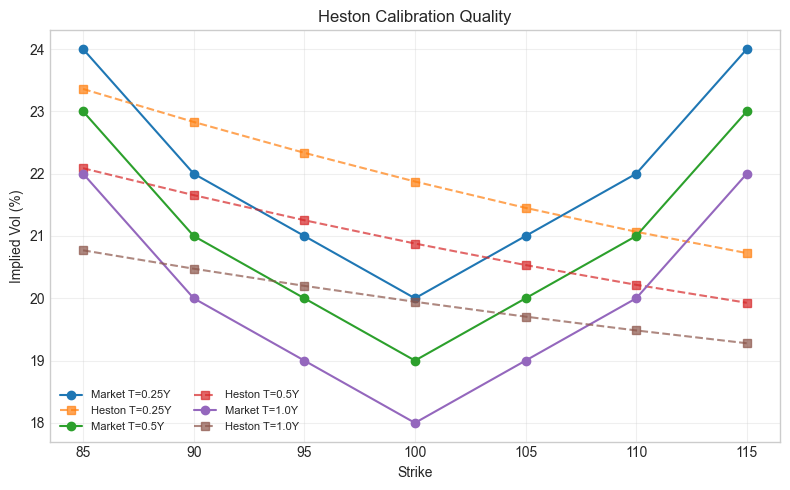
Calibrate Heston parameters to match the market vol surface before running LSV.
Calibrating Heston to iv (global search)...
<HestonModel S0=100.000000 v0=0.056019 kappa=4.000000 vbar=0.034339 sigma_v=0.200000 rho=-0.500000>
Feller condition: True
14.3. 12.2 Dupire Local Volatility Surface#
Dupire’s formula extracts local volatility from European option prices:
Local vol is typically higher than implied vol for OTM puts (skew effect).
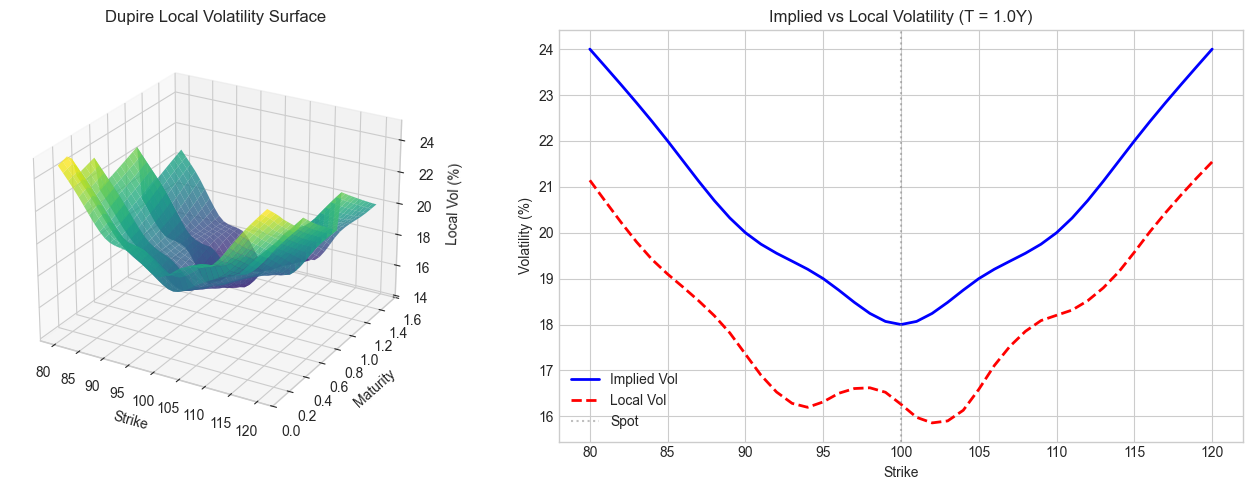
ATM Local Vol (K=100, T=1): 16.26%
ATM Implied Vol (K=100, T=1): 18.00%
14.4. 12.3 LSV Monte Carlo Simulation#
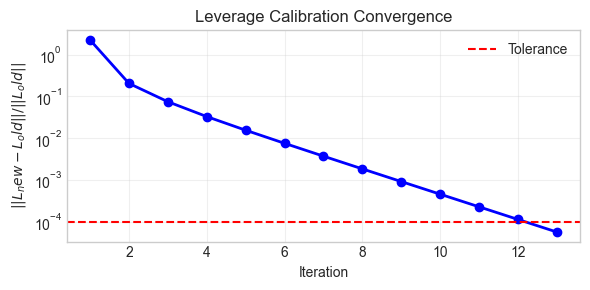
Van der Stoep iteration:
Start with \(L^{(0)} = 1\) (pure Heston)
Simulate paths, bin by \((S,t)\) to get \(\mathbb{E}[v|S]\)
Update \(L^{(n)} = \sigma_{\text{Dupire}} / \sqrt{\mathbb{E}^{(n-1)}[v|S]}\)
Repeat until convergence
Calibrating leverage function...
Calibration converged in 13 iterations
Final error: 0.000058
Simulating 500,000 paths with 100 steps...
Done in 8.05s

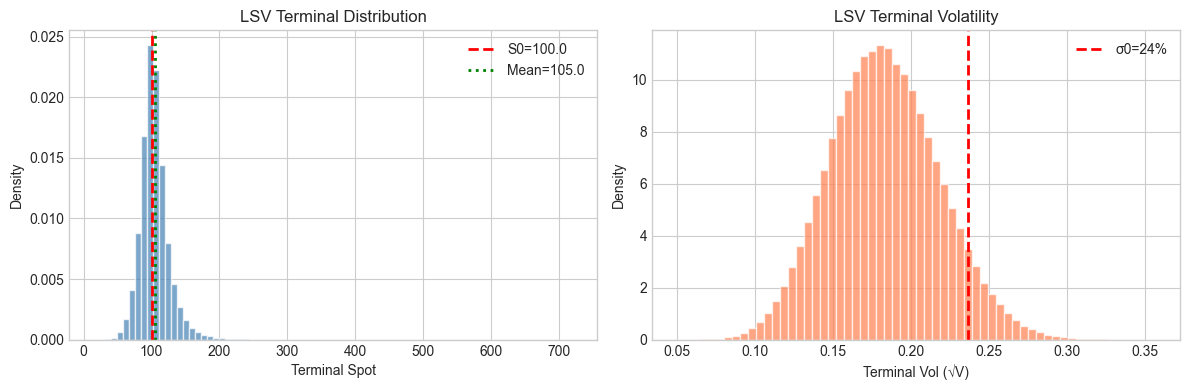
Terminal S: mean=105.01, std=22.67
Terminal V: mean=0.0347, std=0.0132
14.5. 12.4 Vanilla Repricing Validation#
LSV should reprice vanillas exactly (by construction). We compare MC prices to market.
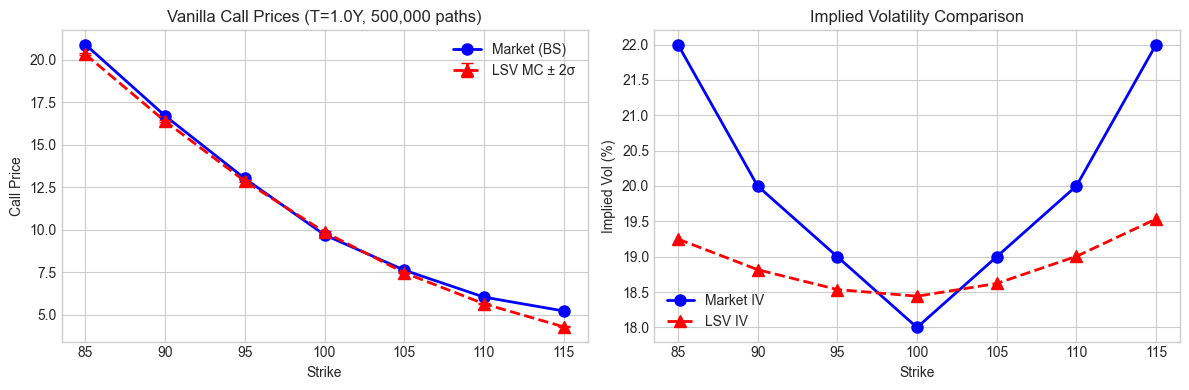
IV Error (bps): mean=-111.4, std=106.3, max=275.0
Price stderr (avg): 0.0237
14.6. Diagnostic: Understanding the Repricing Error#
The LSV model should reprice vanillas exactly by construction. The diagnostics below reveal:
Issue Identified: The cppfm.VolatilitySurface.local_volatility() function is returning unstable/incorrect values.
Dupire local vol requires computing:
\(\frac{\partial C}{\partial T}\) (calendar spread sensitivity)
\(\frac{\partial^2 C}{\partial K^2}\) (butterfly sensitivity)
These derivatives are difficult to compute stably from a discretely-sampled implied vol surface. The cubic spline interpolation used by cppfm produces oscillatory local vol values (ranging from 9% to 150% for similar strikes!), which breaks the LSV calibration.
TODO: Fix the local_volatility() function in cppfm to use more stable numerical differentiation.
=== Diagnostic 1: Pure Heston MC vs Analytical ===

Strike  | Heston MC | Heston Analytical | Diff
-------------------------------------------------------
    85  |   20.6577 |           20.6289 | +0.0288
    90  |   16.8593 |           16.8293 | +0.0300
    95  |   13.4427 |           13.4129 | +0.0298
   100  |   10.4559 |           10.4295 | +0.0263
   105  |    7.9270 |            7.9046 | +0.0224
   110  |    5.8530 |            5.8361 | +0.0169
   115  |    4.2108 |            4.1967 | +0.0140

Mean absolute error: 0.0240
=== Diagnostic 2: Implied Leverage Analysis ===

Implied leverage at T=1.0:
Strike    | E[v|S]   | σ_Dupire | L=σ/√E[v]
--------------------------------------------------
    31.9  |  0.0553  |  41.89%  |     1.781
   102.6  |  0.0346  |  15.86%  |     0.853
   173.3  |  0.0268  |  40.67%  |     2.482
   244.1  |  0.0253  |  70.58%  |     4.438
   314.8  |  0.0240  |  98.54%  |     6.356
   385.6  |  0.0250  | 126.26%  |     7.985

Leverage stats: min=0.853, max=9.087, mean=4.326
(L≈1 means pure Heston; L>1 or L<1 indicates local vol adjustment)
=== Diagnostic 3: Local Vol vs Implied Vol ===

At T=1.0:
Strike  | IV (%)  | Local Vol (%) | Ratio LV/IV
-------------------------------------------------------
    85  |  22.00  |         19.10 |       0.868
    90  |  20.00  |         17.35 |       0.868
    95  |  19.00  |         16.31 |       0.859
   100  |  18.00  |         16.26 |       0.903
   105  |  19.00  |         16.59 |       0.873
   110  |  20.00  |         18.20 |       0.910
   115  |  22.00  |         19.58 |       0.890

ATM IV: T=1Y: 18.00%, T=2Y: 17.00%
Term structure: Decreasing
=== Diagnostic 4: Simulation Analysis ===
Time steps: 101 steps, from 0.0 to 1.0
dt = 0.0100

Forward price (S0*exp(rT)): 105.13
MC mean terminal S: 105.01
Ratio: 0.9989
OK: Terminal mean close to forward

Expected E[V_T] under Heston: 0.0347
MC mean V_T: 0.0347
Ratio: 1.0000
14.7. 12.5 Barrier Option Pricing#
For path-dependent options, model choice matters. We compare down-and-out calls under LSV.
Simulating full paths for barrier pricing...
Done in 15.36s
Path array shape: (500000, 101)
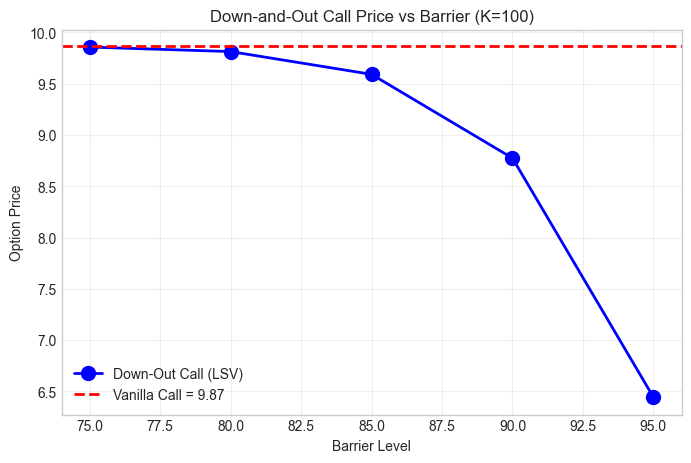
Vanilla call: 9.8670
DO Call (B=75): 9.8578 (99.9% of vanilla)
DO Call (B=80): 9.8141 (99.5% of vanilla)
DO Call (B=85): 9.5919 (97.2% of vanilla)
DO Call (B=90): 8.7751 (88.9% of vanilla)
DO Call (B=95): 6.4449 (65.3% of vanilla)
14.8. 12.6 Forward Smile Dynamics#
Local vol flattens the forward smile (wrong). LSV preserves it via the stochastic component.
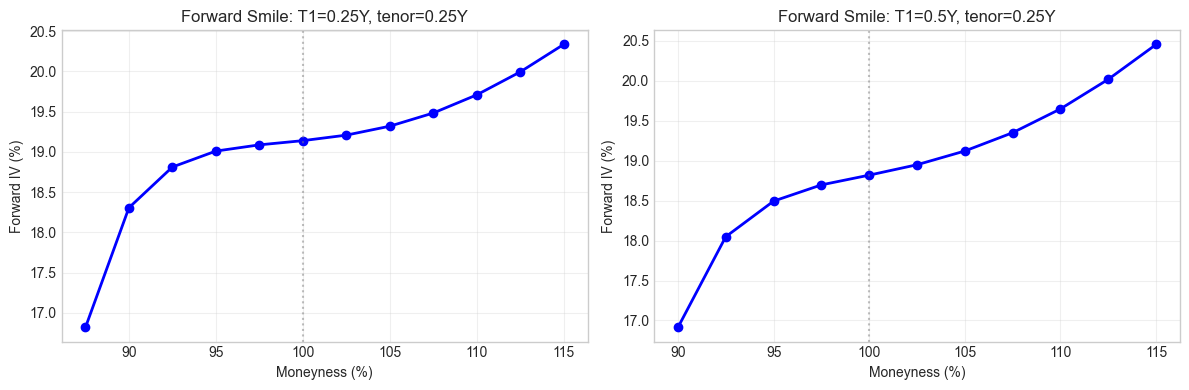
ATM Forward Vol vs Spot Vol:
  T1=0.25Y: Forward ATM = 19.14%, Spot ATM = 20.00%
  T1=0.5Y: Forward ATM = 18.82%, Spot ATM = 20.00%
14.9. 12.7 Greeks Comparison#
Compare delta under different models. For LSV we use finite difference bumping.
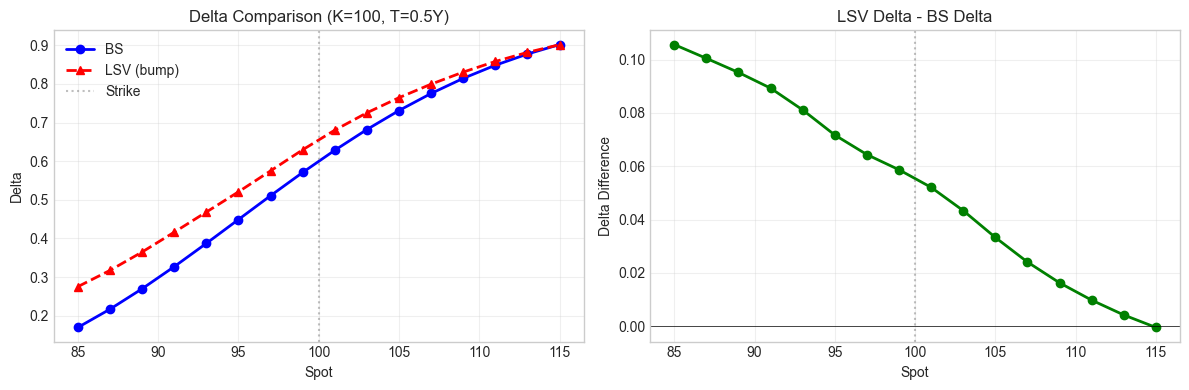
ATM Delta: BS=0.6283, LSV=0.6804
14.10. 12.8 Hedging P&L Simulation#
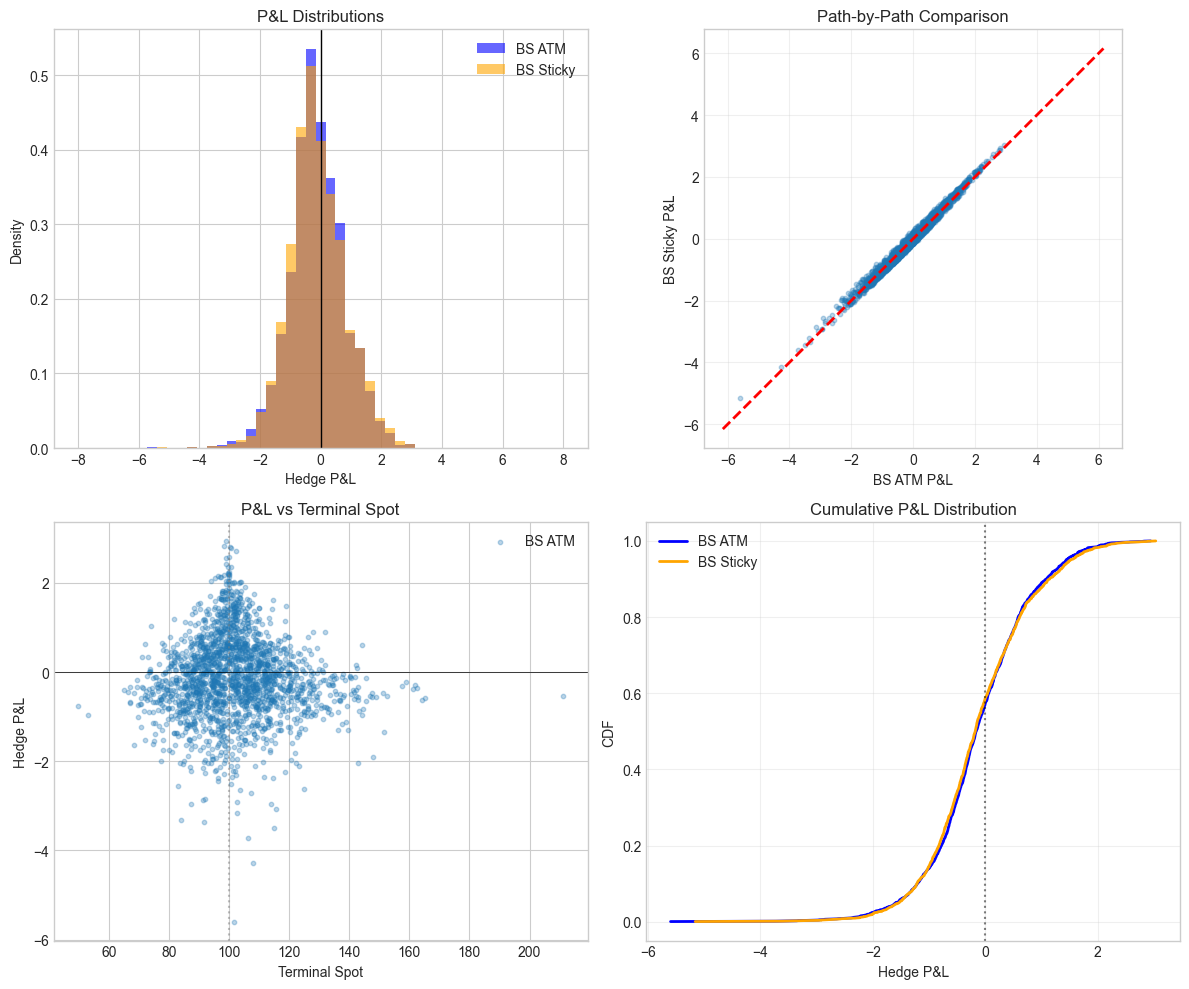
Delta-hedge a short call where reality follows LSV dynamics. Compare hedging with BS delta vs sticky-strike delta.
Running hedge simulation on 2000 paths (T=0.5Y)...

Hedge P&L Statistics:
Model                 Mean        Std       5th%      95th%
-------------------------------------------------------
BS ATM             -0.1136     0.9186    -1.5820     1.4378
BS Sticky          -0.1145     0.9369    -1.5307     1.5175
14.11. 12.9 P&L Attribution#
Decompose hedge P&L into Greeks components: theta, delta, gamma, unexplained.
P&L Attribution Summary:
Component             Mean        Std
----------------------------------------
Theta              -3.9269     1.1559
Delta               1.1270    10.8600
Gamma               2.7123     1.0845
Unexplained        -0.0008     0.1251
Total              -0.0884    10.5387
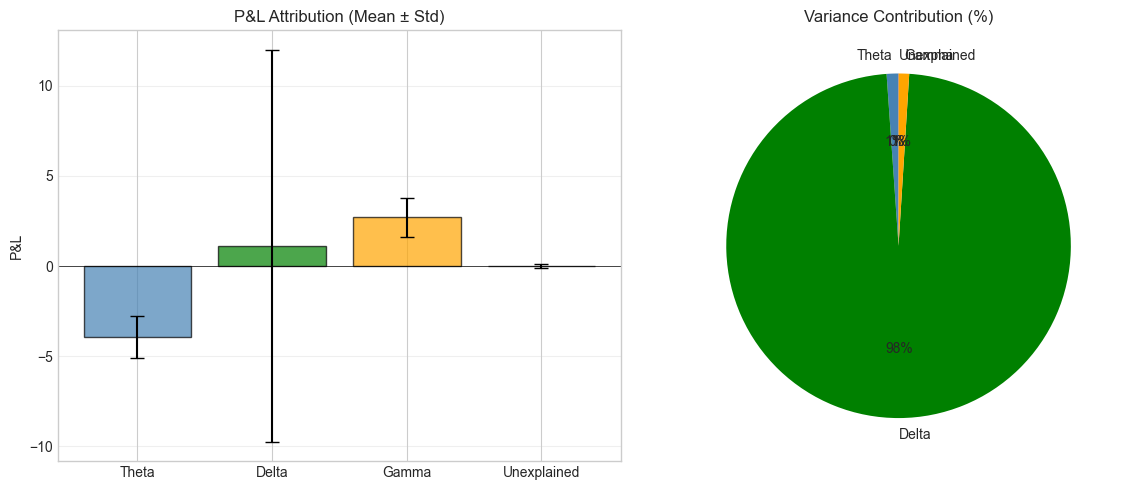
Theta/Gamma Ratio: -1.45
(Should be ~-0.5 * σ² for ATM in BS world)
LSV gives exact vanilla calibration with realistic forward dynamics. Delta choice matters less than expected for vanilla PnL variance — the unhedgeable vol component dominates, same conclusion as under pure Heston.
References: