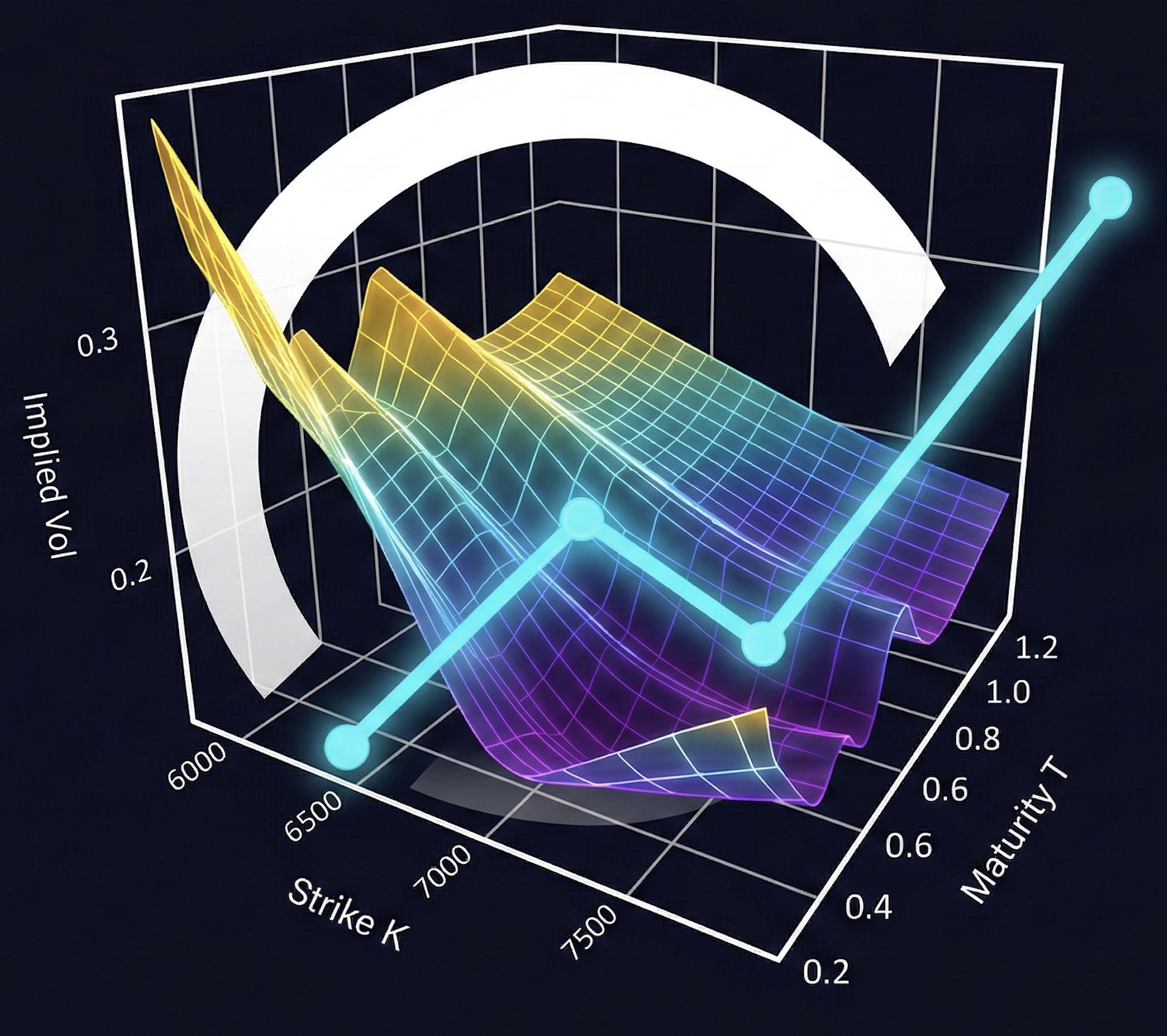
3. Heston Calibration#
Can we recover Heston [1993] parameters from option prices? We generate synthetic market data from known parameters, calibrate back, and see what breaks.
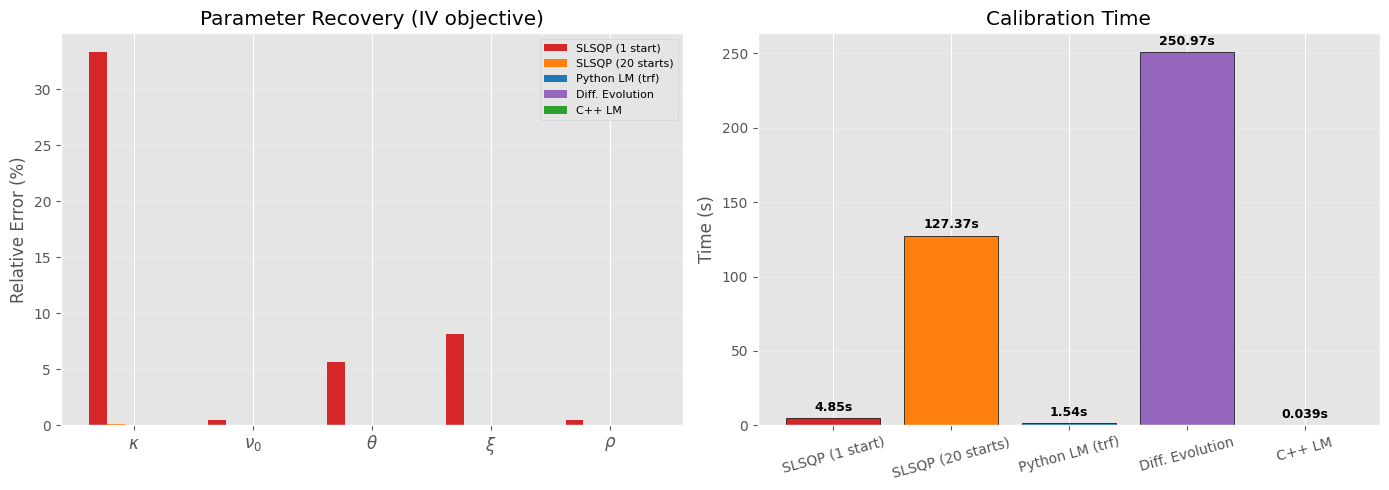
SLSQP with a single starting point gets kappa wrong by 35% — the loss surface is flat in that direction. Levenberg-Marquardt does better, and the Hessian eigenspectrum shows exactly why.
3.1. COS Pricing#
COS [Fang and Oosterlee, 2008] encodes the payoff directly in Fourier-cosine coefficients — no numerical integration, exponential convergence. The characteristic function uses the stable formulation from Albrecher et al. [2007] to avoid the branch cut issue.
3.2. Sanity check: COS convergence#
Gil-Pelaez with n=200 is itself approximate. We use a high-resolution reference (n=10000) and check both methods against it.
     K      T    Reference     COS(128)      GP(200)    COS err     GP err
---------------------------------------------------------------------------
80 0.25 21.673670 21.673670 21.672486 4.26e-10 1.18e-03
100 0.50 9.323819 9.323819 9.324225 3.78e-08 4.06e-04
120 1.00 4.396658 4.396657 4.396639 2.85e-07 1.85e-05
90 0.25 13.211971 13.211971 13.210964 5.23e-10 1.01e-03
110 0.50 4.452662 4.452662 4.452337 2.00e-08 3.26e-04
3.3. Synthetic market data#
We know the true parameters, so we can measure how badly calibration recovers them. Using COS for both data generation and calibration — otherwise method mismatch contaminates the experiment.
True params: kappa=1.5, nu0=0.0400, theta=0.0600, xi=0.4, rho=-0.7
Feller check: 2*kappa*theta - xi^2 = 0.0200 > 0
27 instruments across 3 maturities, strikes 80-120

       K      T       IV      Price
    80.0   0.25    26.3%    21.1631
    85.0   0.25    24.9%    16.4659
    90.0   0.25    23.4%    12.0261
    95.0   0.25    22.0%     8.0282
   100.0   0.25    20.5%     4.7065
   105.0   0.25    19.0%     2.2859
   110.0   0.25    17.6%     0.8577
   115.0   0.25    16.6%     0.2398
   120.0   0.25    16.0%     0.0524
    80.0   0.50    26.0%    22.6400
    85.0   0.50    24.7%    18.2513
    90.0   0.50    23.5%    14.1344
    95.0   0.50    22.2%    10.3915
   100.0   0.50    20.9%     7.1382
   105.0   0.50    19.7%     4.4886
   110.0   0.50    18.5%     2.5250
   115.0   0.50    17.5%     1.2485
   120.0   0.50    16.7%     0.5434
    80.0   1.00    25.7%    25.5434
    85.0   1.00    24.6%    21.5169
    90.0   1.00    23.6%    17.7304
    95.0   1.00    22.6%    14.2345
   100.0   1.00    21.7%    11.0814
   105.0   1.00    20.8%     8.3204
   110.0   1.00    19.9%     5.9915
   115.0   1.00    19.1%     4.1158
   120.0   1.00    18.3%     2.6871
3.4. Calibration setup#
Two objectives: MSE on prices vs MSE on implied vols. Feller constraint \(2\kappa\theta > \xi^2\) enforced via both inequality constraints and explicit parameter bounds.
3.5. Price-MSE calibration#
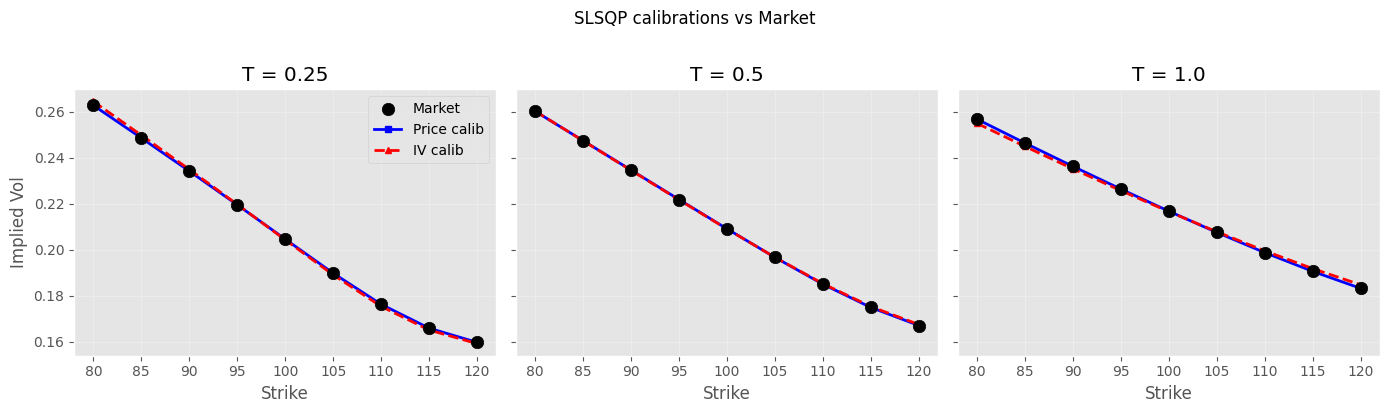
SLSQP Price-MSE calibration (0.94s)

   Param   Calibrated         True    Rel Error
------------------------------------------------
   kappa     1.500004       1.5000       0.00%
     nu0     0.040000       0.0400       0.00%
   theta     0.059998       0.0600       0.00%
      xi     0.399911       0.4000       0.02%
     rho    -0.700125      -0.7000       0.02%

Feller: 2*kappa*theta - xi^2 = 0.0201 > 0
Converged: True, Iterations: 25, Final MSE: 9.84e-10
3.6. IV-MSE calibration#
Does matching implied vols instead of prices help?
SLSQP IV-MSE calibration (4.85s)

   Param   Calibrated         True    Rel Error
------------------------------------------------
   kappa     1.999940       1.5000      33.33%
     nu0     0.039804       0.0400       0.49%
   theta     0.056586       0.0600       5.69%
      xi     0.432592       0.4000       8.15%
     rho    -0.696388      -0.7000       0.52%

Feller: 2*kappa*theta - xi^2 = 0.0392 > 0
Converged: True, Iterations: 23, Final MSE: 7.15e-07
3.7. IV smile fit#
3.8. Python Levenberg-Marquardt#
SLSQP treats the MSE as a scalar — it can’t see the structure of individual residuals. least_squares with method='trf' (trust-region reflective, LM variant with bounds support) exploits the least-squares structure and uses the Jacobian of the residual vector. Same Python, same COS pricer — only the algorithm changes.
Python LM Price-MSE (0.37s, 11 func evals)

   Param   Calibrated         True    Rel Error
------------------------------------------------
   kappa     1.500000       1.5000       0.00%
     nu0     0.040000       0.0400       0.00%
   theta     0.060000       0.0600       0.00%
      xi     0.400000       0.4000       0.00%
     rho    -0.700000      -0.7000       0.00%

Feller: 2*kappa*theta - xi^2 = 0.0200 > 0
Python LM IV-MSE (1.54s, 7 func evals)

   Param   Calibrated         True    Rel Error
------------------------------------------------
   kappa     1.500000       1.5000       0.00%
     nu0     0.040000       0.0400       0.00%
   theta     0.060000       0.0600       0.00%
      xi     0.400000       0.4000       0.00%
     rho    -0.700000      -0.7000       0.00%

Feller: 2*kappa*theta - xi^2 = 0.0200 > 0
3.9. Multi-start and global optimization#
Single starting point on a flat loss surface is unreliable. differential_evolution searches globally — no starting point needed. We also run a multi-start SLSQP for comparison.
# differential evolution — global optimizer, no starting point bias
de_bounds = list(zip(bounds_lower, bounds_upper))

t0 = time.time()
result_de = differential_evolution(MSE_IV_COS, de_bounds, seed=42, tol=1e-8,
                                   maxiter=100, polish=True)
time_de = time.time() - t0
params_de = result_de.x

print(f"Differential Evolution IV-MSE ({time_de:.1f}s)\n")
print_calib_result(params_de, result_de)

# multi-start SLSQP: 20 random starting points, keep best
np.random.seed(42)
best_mse = np.inf
best_params = None
n_starts = 20

t0 = time.time()
for _ in range(n_starts):
    p0 = [np.random.uniform(lo, hi) for lo, hi in de_bounds]
    try:
        res = minimize(MSE_IV_COS, p0, constraints=cons, method='SLSQP',
                       bounds=de_bounds, tol=1e-10)
        if res.fun < best_mse:
            best_mse = res.fun
            best_params = res.x.copy()
    except:
        continue
time_ms = time.time() - t0

print(f"\nMulti-start SLSQP ({n_starts} starts, {time_ms:.1f}s)\n")
print_calib_result(best_params)
Differential Evolution IV-MSE (251.0s)

   Param   Calibrated         True    Rel Error
------------------------------------------------
   kappa     1.501055       1.5000       0.07%
     nu0     0.040000       0.0400       0.00%
   theta     0.059990       0.0600       0.02%
      xi     0.400074       0.4000       0.02%
     rho    -0.699965      -0.7000       0.01%

Feller: 2*kappa*theta - xi^2 = 0.0200 > 0
Converged: False, Iterations: 100, Final MSE: 4.95e-12
Multi-start SLSQP (20 starts, 127.4s)

   Param   Calibrated         True    Rel Error
------------------------------------------------
   kappa     1.501218       1.5000       0.08%
     nu0     0.040000       0.0400       0.00%
   theta     0.059995       0.0600       0.01%
      xi     0.400069       0.4000       0.02%
     rho    -0.700029      -0.7000       0.00%

Feller: 2*kappa*theta - xi^2 = 0.0201 > 0
# C++ Levenberg-Marquardt
# generate reference IVs from C++ pricer — same method for generation and calibration
# NOTE: C++ pricer uses a different pricing method (Gauss-Laguerre) than COS above,
# so the reference IVs differ by a few bps. The comparison chart is not perfectly
# apples-to-apples vs the Python calibrations, but the conclusion holds.

T_unique = T_maturities
K_unique = K_strikes
n_K = len(K_unique)

IV_mkt_cpp = []
for i in range(n_instruments):
    price_cpp = cppfm.heston_call_price(S0, K_mkt[i], r, T_mkt[i],
                                            true_kappa, true_theta, true_xi, true_rho, true_nu0)
    IV_mkt_cpp.append(cppfm.bs_implied_volatility(S0, K_mkt[i], r, T_mkt[i], price_cpp,
                                                    cppfm.OptionType.Call))

slices = []
for T in T_unique:
    s = cppfm.HestonSliceData()
    s.T = T
    mask = [i for i in range(n_instruments) if T_mkt[i] == T]
    s.strikes = [K_mkt[i] for i in mask]
    s.market_ivs = [IV_mkt_cpp[i] for i in mask]
    slices.append(s)

guess = cppfm.HestonParams(v0=0.25**2, kappa=2.0, vbar=0.25**2, sigma_v=0.5, rho=-0.8)

t0 = time.time()
result_cpp = cppfm.calibrate_heston(slices, S0=S0, r=r, guess=guess)
time_cpp = time.time() - t0

p = result_cpp.params
params_cpp = [p.kappa, p.v0, p.vbar, p.sigma_v, p.rho]
print(f"C++ LM: {result_cpp.iterations} iters, RMSE={result_cpp.rmse:.2e}, {time_cpp:.4f}s")
print(f"Converged: {result_cpp.converged}\n")
print_calib_result(params_cpp)
C++ LM: 6 iters, RMSE=4.86e-09, 0.0391s
Converged: True

   Param   Calibrated         True    Rel Error
------------------------------------------------
   kappa     1.499997       1.5000       0.00%
     nu0     0.040000       0.0400       0.00%
   theta     0.060000       0.0600       0.00%
      xi     0.400000       0.4000       0.00%
     rho    -0.700000      -0.7000       0.00%

Feller: 2*kappa*theta - xi^2 = 0.0200 > 0
# all-methods comparison
all_methods = {
    'SLSQP (1 start)': (params_iv_cos, time_iv_cos),
    'SLSQP (20 starts)': (best_params, time_ms),
    'Python LM (trf)': (params_lm_iv, time_lm_iv),
    'Diff. Evolution': (params_de, time_de),
    'C++ LM': (params_cpp, time_cpp),
}

n_methods = len(all_methods)
fig, (ax1, ax2) = plt.subplots(1, 2, figsize=(14, 5))

x = np.arange(5)
width = 0.15
colors = ['#d62728', '#ff7f0e', '#1f77b4', '#9467bd', '#2ca02c']

for j, (method, (params, _)) in enumerate(all_methods.items()):
    errors = [abs(params[i] - true_params[i]) / abs(true_params[i]) * 100 for i in range(5)]
    ax1.bar(x + (j - n_methods//2)*width, errors, width, label=method, color=colors[j])

ax1.set_xticks(x)
ax1.set_xticklabels([r'$\kappa$', r'$\nu_0$', r'$\theta$', r'$\xi$', r'$\rho$'], fontsize=12)
ax1.set_ylabel('Relative Error (%)')
ax1.set_title('Parameter Recovery (IV objective)')
ax1.legend(fontsize=8)
ax1.grid(True, alpha=0.3, axis='y')

# timing
method_names = list(all_methods.keys())
times_list = [t for _, t in all_methods.values()]
bars = ax2.bar(method_names, times_list, color=colors[:n_methods], edgecolor='black', linewidth=0.5)
ax2.set_ylabel('Time (s)')
ax2.set_title('Calibration Time')
for bar, t in zip(bars, times_list):
    label = f'{t:.2f}s' if t >= 0.1 else f'{t:.3f}s'
    ax2.text(bar.get_x() + bar.get_width()/2, bar.get_height() + max(times_list)*0.02,
             label, ha='center', fontsize=9, fontweight='bold')
ax2.grid(True, alpha=0.3, axis='y')
ax2.tick_params(axis='x', rotation=15)

plt.tight_layout()
plt.show()
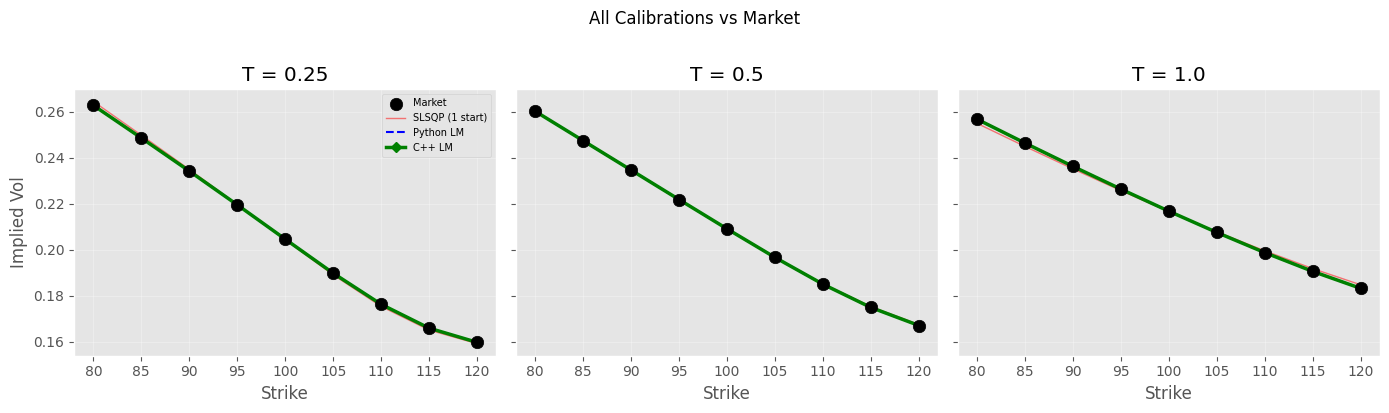
Did it find the global minimum? Yes, but with a caveat — LM is a local optimizer. It found the global minimum here because:
This is synthetic data (true params are the global min by construction)
# IVs from all methods
def compute_ivs(params_calib):
    return [implied_vol(Heston_price_COS(S0, K_mkt[i], T_mkt[i], r, *params_calib),
                        S0, K_mkt[i], r, T_mkt[i]) for i in range(n_instruments)]

IV_lm = compute_ivs(params_lm_iv)
IV_de = compute_ivs(params_de)

IV_cpp = []
for i in range(n_instruments):
    price = cppfm.heston_call_price(S0, K_mkt[i], r, T_mkt[i],
                                     p.kappa, p.vbar, p.sigma_v, p.rho, p.v0)
    IV_cpp.append(implied_vol(price, S0, K_mkt[i], r, T_mkt[i]))

T_unique = T_maturities
K_unique = K_strikes
n_K = len(K_unique)

fig, axs = plt.subplots(1, 3, figsize=(14, 4), sharey=True)

for j, T in enumerate(T_unique):
    idx = slice(j*n_K, (j+1)*n_K)

    axs[j].scatter(K_unique, IV_mkt[idx], s=80, c='black', marker='o',
                   label='Market', zorder=3)
    axs[j].plot(K_unique, IV_iv_cos[idx], 'r-', lw=1, alpha=0.5, label='SLSQP (1 start)')
    axs[j].plot(K_unique, IV_lm[idx], 'b--', lw=1.5, label='Python LM')
    axs[j].plot(K_unique, IV_cpp[idx], 'g-', lw=2.5, marker='D',
                markersize=5, label='C++ LM')

    axs[j].set_xlabel('Strike')
    axs[j].set_title(f'T = {T}')
    axs[j].grid(True, alpha=0.3)

axs[0].set_ylabel('Implied Vol')
axs[0].legend(loc='upper right', fontsize=7)
plt.suptitle('All Calibrations vs Market', y=1.02)
plt.tight_layout()
plt.show()
3.10. Hessian analysis: why kappa is hard to pin down#
Assertions about “flat loss surface” need proof. The Hessian of the objective at the optimum tells us which parameter directions are well-constrained (large eigenvalues) and which are sloppy (small eigenvalues). The eigenvector associated with the smallest eigenvalue points along the valley floor.
# Hessian via finite differences at the best Python result
from scipy.optimize import approx_fprime

def hessian_fd(f, x, eps=1e-5):
    """Hessian via central finite differences."""
    n = len(x)
    H = np.zeros((n, n))
    for i in range(n):
        def gi(xi_val):
            x_copy = x.copy()
            x_copy[i] = xi_val
            return approx_fprime(x_copy, f, eps)
        g_plus = gi(x[i] + eps)
        g_minus = gi(x[i] - eps)
        H[i] = (g_plus - g_minus) / (2 * eps)
    # symmetrize
    return 0.5 * (H + H.T)

# use the best result we have (DE or LM)
params_best = params_de
H = hessian_fd(MSE_IV_COS, params_best)

eigvals, eigvecs = np.linalg.eigh(H)

print("Hessian eigenspectrum at optimum:")
print(f"{'Eigenvalue':>14}  {'Condition':>10}  Direction (kappa, nu0, theta, xi, rho)")
print("-" * 80)
for i in range(5):
    v = eigvecs[:, i]
    cond = eigvals[-1] / max(eigvals[i], 1e-20)
    # normalize for readability
    v_str = "  ".join([f"{param_names[j]}:{v[j]:+.3f}" for j in range(5)])
    print(f"{eigvals[i]:>14.2e}  {cond:>10.1f}x  [{v_str}]")

print(f"\nCondition number: {eigvals[-1] / max(eigvals[0], 1e-20):.0f}")

# which parameters dominate the flattest direction?
flat_dir = eigvecs[:, 0]
print(f"\nFlattest direction dominated by: ", end="")
sorted_idx = np.argsort(np.abs(flat_dir))[::-1]
for idx in sorted_idx[:3]:
    print(f"{param_names[idx]} ({flat_dir[idx]:+.3f})  ", end="")

# visualize: eigenvalue spectrum
fig, (ax1, ax2) = plt.subplots(1, 2, figsize=(12, 4))

ax1.bar(range(5), eigvals, color=['#d62728' if e == eigvals[0] else '#2ca02c' for e in eigvals])
ax1.set_xticks(range(5))
ax1.set_xticklabels([f'$\\lambda_{i+1}$' for i in range(5)])
ax1.set_ylabel('Eigenvalue')
ax1.set_title('Hessian Eigenspectrum')
ax1.set_yscale('log')
ax1.grid(True, alpha=0.3, axis='y')

# eigenvector heatmap
im = ax2.imshow(np.abs(eigvecs), cmap='YlOrRd', aspect='auto')
ax2.set_xticks(range(5))
ax2.set_xticklabels([f'$\\lambda_{i+1}$' for i in range(5)])
ax2.set_yticks(range(5))
ax2.set_yticklabels([r'$\kappa$', r'$\nu_0$', r'$\theta$', r'$\xi$', r'$\rho$'])
ax2.set_title('|Eigenvector| Components')
plt.colorbar(im, ax=ax2)

# annotate values
for i in range(5):
    for j in range(5):
        ax2.text(j, i, f'{eigvecs[i,j]:+.2f}', ha='center', va='center', fontsize=8,
                 color='white' if abs(eigvecs[i,j]) > 0.5 else 'black')

plt.tight_layout()
plt.show()
Hessian eigenspectrum at optimum:
    Eigenvalue   Condition  Direction (kappa, nu0, theta, xi, rho)
--------------------------------------------------------------------------------
      6.58e-06    894767.9x  [kappa:+0.998  nu0:-0.000  theta:-0.009  xi:+0.063  rho:+0.005]
      6.08e-04      9690.2x  [kappa:-0.041  nu0:-0.009  theta:+0.027  xi:+0.592  rho:+0.804]
      1.07e-02       549.3x  [kappa:+0.047  nu0:+0.002  theta:-0.050  xi:-0.801  rho:+0.594]
      3.20e-01        18.4x  [kappa:-0.012  nu0:+0.402  theta:-0.914  xi:+0.054  rho:-0.005]
      5.89e+00         1.0x  [kappa:+0.005  nu0:+0.916  theta:+0.402  xi:-0.016  rho:+0.009]

Condition number: 894768

Flattest direction dominated by: kappa (+0.998)  xi (+0.063)  theta (-0.009)
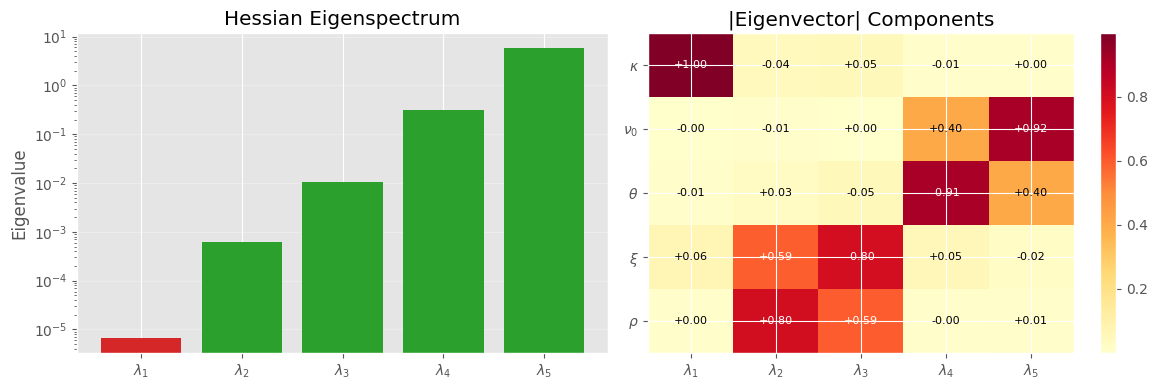
Interpretation:
Hessian is the curvature matrix of the loss function at the optimum. Its eigenvalues tell us how steep/flat the loss surface is in each direction:
Large eigenvalue = steep valley -> parameter is well-identified. Moving away a tiny-bit costs a lot.
Small eigenvalue = nearly flat region -> parameter is poorly identified. E.g. changing kappa by a lot barely moves the loss - so the optimizer just “slides along the floor”
Condition number = ratio of steepest to flattest.
The heatmap:
To see this, imagine the loss surface as a 5D bowl, not symmetric one. Each eigenvector represents a direction in the parameter space.
Each column is an eigen-direction, each row is a parameter.
Darker the color the parameter contributes more in that direction.
i.e. when the optimizer moves along that eigen-direction, that parameter is the one changing. A parameter that’s dark in a flat column (small eigenvalue) is one the data cannot control well.