11. Greeks via COS Method#

COS computes Greeks through Fourier series derivatives. We validate against BS closed-form before moving to stochastic vol.

Hide code cell source

import numpy as np
import matplotlib.pyplot as plt
import pandas as pd
import ipywidgets as widgets
from ipywidgets import interactive

from cos_greeks import cos_greeks_full, bs_greeks_analytical, cos_price

11.1. COS Greeks Formulas#

From Fang and Oosterlee [2008], the COS option price is:

\[C = K e^{-rT} \sum_{k=0}^{N-1}\phantom{}' \text{Re}[H_k] V_k\]

where \(H_k = \varphi\left(\frac{k\pi}{b-a}\right) e^{ik\pi\frac{x_0 - a}{b-a}}\) and \(V_k\) are payoff coefficients.

Delta - differentiate w.r.t. \(S_0\) (enters through \(x_0 = \ln(S_0/K)\)):

\[\Delta = -\frac{Ke^{-rT}}{S_0} \sum_{k=0}^{N-1}\phantom{}' \omega_k \, \text{Im}[H_k] V_k\]

where \(\omega_k = \frac{k\pi}{b-a}\).

Gamma - second derivative:

\[\Gamma = \frac{Ke^{-rT}}{S_0^2} \sum_{k=0}^{N-1}\phantom{}' \left(\omega_k \, \text{Im}[H_k] - \omega_k^2 \, \text{Re}[H_k]\right) V_k\]

Theta, Vega, Rho - computed via finite differences. Analytical formulas exist but FD is simpler and accurate enough for validation.

11.2. Point Comparison: COS vs Black-Scholes#

ATM call, standard parameters.

Hide code cell source

# test params
S0, K, T, r, sigma = 100, 100, 1.0, 0.05, 0.2

bs = bs_greeks_analytical(S0, K, T, r, sigma, 'call')
cos = cos_greeks_full(S0, K, T, r, sigma, model='bs', N=256, L=12, opt_type='call')

# build comparison table
greeks = ['price', 'delta', 'gamma', 'theta', 'vega', 'rho']
rows = []
for g in greeks:
    bs_val = bs[g]
    cos_val = cos[g]
    err = abs(cos_val - bs_val)
    rel_err = err / abs(bs_val) if abs(bs_val) > 1e-10 else err
    rows.append([g, bs_val, cos_val, err, rel_err])

df = pd.DataFrame(rows, columns=['Greek', 'BS Analytical', 'COS Method', 'Abs Error', 'Rel Error'])
df.set_index('Greek', inplace=True)
df.style.format({'BS Analytical': '{:.6f}', 'COS Method': '{:.6f}', 'Abs Error': '{:.2e}', 'Rel Error': '{:.2e}'})
  BS Analytical COS Method Abs Error Rel Error
Greek        
price 10.450584 10.450584 1.78e-15 1.70e-16
delta 0.636831 0.636831 1.54e-14 2.42e-14
gamma 0.018762 0.018762 1.08e-16 5.73e-15
theta -6.414028 -6.415077 1.05e-03 1.64e-04
vega 37.524035 37.524034 3.04e-07 8.11e-09
rho 53.232482 53.232481 7.72e-07 1.45e-08

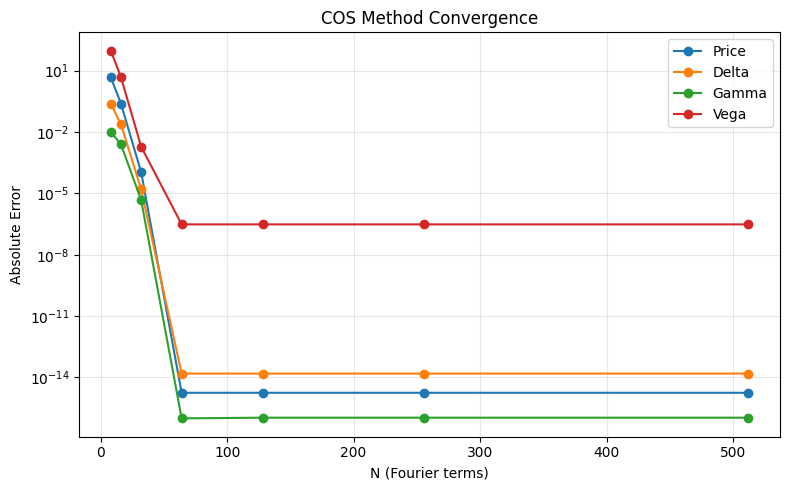
11.3. Convergence Analysis#

How does error decay as we increase the number of Fourier terms N?
Hide code cell source

S0, K, T, r, sigma = 100, 100, 1.0, 0.05, 0.2
bs = bs_greeks_analytical(S0, K, T, r, sigma, 'call')

N_values = [8, 16, 32, 64, 128, 256, 512]
greeks_to_plot = ['price', 'delta', 'gamma', 'vega']

errors = {g: [] for g in greeks_to_plot}
for N in N_values:
    cos = cos_greeks_full(S0, K, T, r, sigma, model='bs', N=N, L=12, opt_type='call')
    for g in greeks_to_plot:
        err = abs(cos[g] - bs[g])
        errors[g].append(err if err > 1e-16 else 1e-16)  # floor for log scale

fig, ax = plt.subplots(figsize=(8, 5))
for g in greeks_to_plot:
    ax.semilogy(N_values, errors[g], 'o-', label=g.capitalize())

ax.set_xlabel('N (Fourier terms)')
ax.set_ylabel('Absolute Error')
ax.set_title('COS Method Convergence')
ax.legend()
ax.grid(True, alpha=0.3)
plt.tight_layout()
../_images/6e8a56e2352d9570762e99fc7e2674edd9ba5d5724810fb60faaad8f287a8023.png

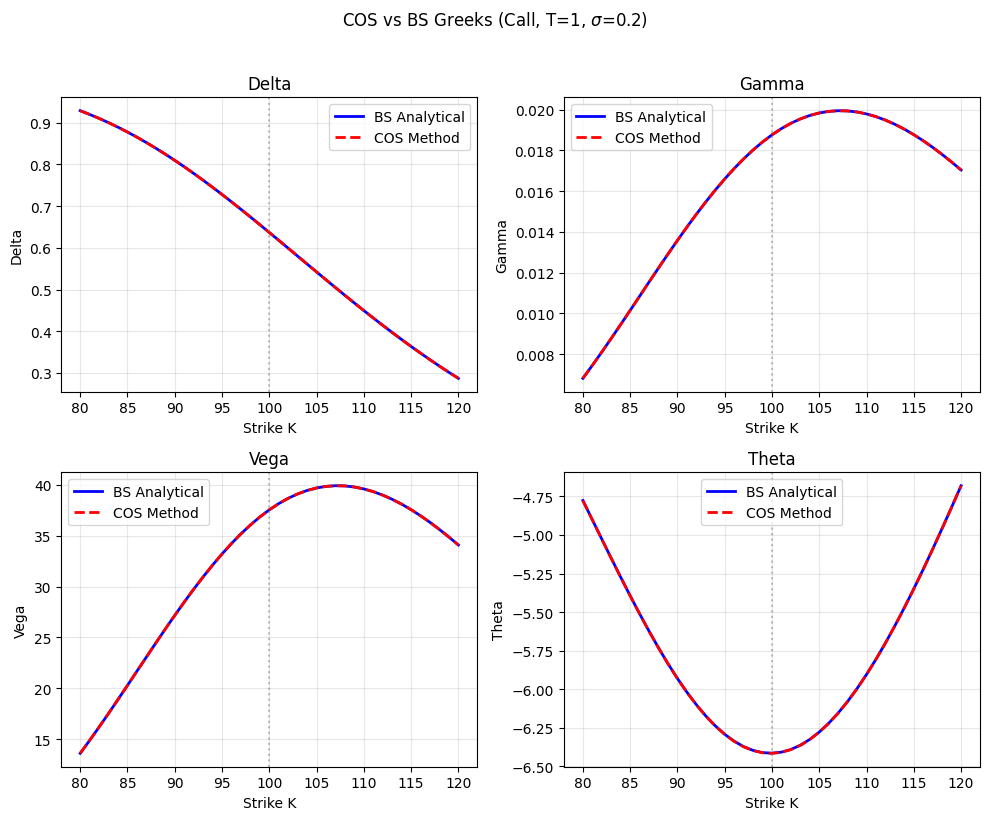
11.4. Greeks Across Strikes#

Compare COS and BS Greeks for strikes from deep ITM to deep OTM.
Hide code cell source

S0, T, r, sigma = 100, 1.0, 0.05, 0.2
K_range = np.linspace(80, 120, 41)

greeks_to_show = ['delta', 'gamma', 'vega', 'theta']
bs_vals = {g: [] for g in greeks_to_show}
cos_vals = {g: [] for g in greeks_to_show}

for K in K_range:
    bs = bs_greeks_analytical(S0, K, T, r, sigma, 'call')
    cos = cos_greeks_full(S0, K, T, r, sigma, model='bs', N=256, L=12, opt_type='call')
    for g in greeks_to_show:
        bs_vals[g].append(bs[g])
        cos_vals[g].append(cos[g])

fig, axes = plt.subplots(2, 2, figsize=(10, 8))
axes = axes.flatten()

for idx, g in enumerate(greeks_to_show):
    ax = axes[idx]
    ax.plot(K_range, bs_vals[g], 'b-', lw=2, label='BS Analytical')
    ax.plot(K_range, cos_vals[g], 'r--', lw=2, label='COS Method')
    ax.axvline(S0, color='gray', linestyle=':', alpha=0.5)
    ax.set_xlabel('Strike K')
    ax.set_ylabel(g.capitalize())
    ax.set_title(g.capitalize())
    ax.legend()
    ax.grid(True, alpha=0.3)

plt.suptitle('COS vs BS Greeks (Call, T=1, $\\sigma$=0.2)', y=1.02)
plt.tight_layout()
../_images/b714491bc4a58975f9e6c65804ef0dc58d53bce2ea759d021e00f49258073428.png

11.5. Interactive Comparison#

Overlay COS and BS Greeks across spot prices. Check the match holds under different parameter regimes.

Hide code cell source

def compare_greeks(K=100, T=1.0, r=0.05, sigma=0.2, opt_type='call', greek='delta'):
    S_range = np.linspace(50, 150, 51)
    
    bs_values = []
    cos_values = []
    
    for S in S_range:
        bs = bs_greeks_analytical(S, K, T, r, sigma, opt_type)
        cos = cos_greeks_full(S, K, T, r, sigma, model='bs', N=256, L=12, opt_type=opt_type)
        bs_values.append(bs[greek])
        cos_values.append(cos[greek])
    
    bs_values = np.array(bs_values)
    cos_values = np.array(cos_values)
    
    fig, (ax1, ax2) = plt.subplots(1, 2, figsize=(12, 4))
    
    # left: overlay
    ax1.plot(S_range, bs_values, 'b-', lw=2, label='BS Analytical')
    ax1.plot(S_range, cos_values, 'r--', lw=2, label='COS Method')
    ax1.axvline(K, color='gray', linestyle=':', alpha=0.7, label=f'K={K}')
    ax1.set_xlabel('Spot Price S')
    ax1.set_ylabel(greek.capitalize())
    ax1.set_title(f'{greek.capitalize()} ({opt_type})')
    ax1.legend()
    ax1.grid(True, alpha=0.3)
    
    # right: error
    error = np.abs(cos_values - bs_values)
    ax2.semilogy(S_range, error + 1e-16, 'k-', lw=1.5)
    ax2.axvline(K, color='gray', linestyle=':', alpha=0.7)
    ax2.set_xlabel('Spot Price S')
    ax2.set_ylabel('Absolute Error')
    ax2.set_title(f'{greek.capitalize()} Error')
    ax2.grid(True, alpha=0.3)
    
    plt.tight_layout()
    plt.show()
    
    # summary stats
    print(f"Max error: {error.max():.2e}, Mean error: {error.mean():.2e}")

interactive_plot = interactive(
    compare_greeks,
    K=widgets.FloatSlider(min=50, max=150, step=5, value=100, description='K'),
    T=widgets.FloatSlider(min=0.1, max=3, step=0.1, value=1.0, description='T'),
    r=widgets.FloatSlider(min=0, max=0.15, step=0.01, value=0.05, description='r'),
    sigma=widgets.FloatSlider(min=0.05, max=0.8, step=0.05, value=0.2, description='sigma'),
    opt_type=widgets.Dropdown(options=['call', 'put'], value='call', description='Type'),
    greek=widgets.Dropdown(options=['price', 'delta', 'gamma', 'theta', 'vega', 'rho'], 
                           value='delta', description='Greek')
)

display(interactive_plot)

COS matches BS Greeks to high precision (errors ~1e-6 for analytical, ~1e-4 for FD). Same code works for Heston or rough vol — just swap the characteristic function.