1. Recovering PDF/CDF from Characteristic Functions#
If the characteristic function is known, we can recover the PDF and CDF without needing the density in closed form. The characteristic function of a random variable \(X\):
is the Fourier transform of the density. Inverting it gives us back the PDF:
This is useful for option pricing when we have an analytical CF (Black-Scholes, Heston, Variance-Gamma, etc.) but no closed-form density. We can price options by computing:
Three methods for this inversion: COS, Carr-Madan, and CONV. Each has different convergence properties. COS converges exponentially (N~64 for machine precision on smooth densities), Carr-Madan and CONV algebraically (N~256+).
1.1. COS Method#
The COS method Fang and Oosterlee [2008] expands the density as a Fourier cosine series on \([a,b]\):
The coefficients \(A_k\) can be computed directly from the characteristic function:
No numerical integration needed — just evaluate the CF at specific frequencies. For smooth densities, convergence is exponential: \(O(\rho^N)\) with \(\rho < 1\). With N=64 you often hit machine precision.
The CDF follows by integrating the series:
where \(\omega_k = k\pi/(b-a)\).
Domain \([a,b]\) should capture most of the probability mass — typically \([\mu - L\sigma, \mu + L\sigma]\) with \(L \approx 10\).
Standard normal density recovery — sweep N from 4 to 64 on \([-10, 10]\) and measure max absolute error.
Convergence table:
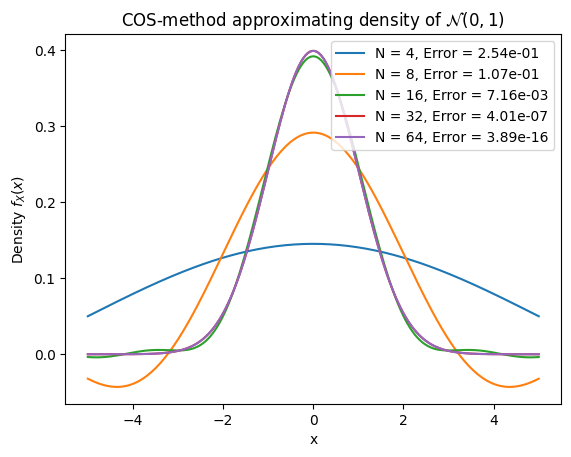
    N         Error  CPU time (msec.)  Diff. in CPU (msec.)
0   4  2.536344e-01          0.073695                   NaN
1   8  1.074376e-01          0.034595             -0.039101
2  16  7.158203e-03          0.052738              0.018144
3  32  4.008963e-07          0.101948              0.049210
4  64  3.885781e-16          0.181580              0.079632

Testing CDF recovery:
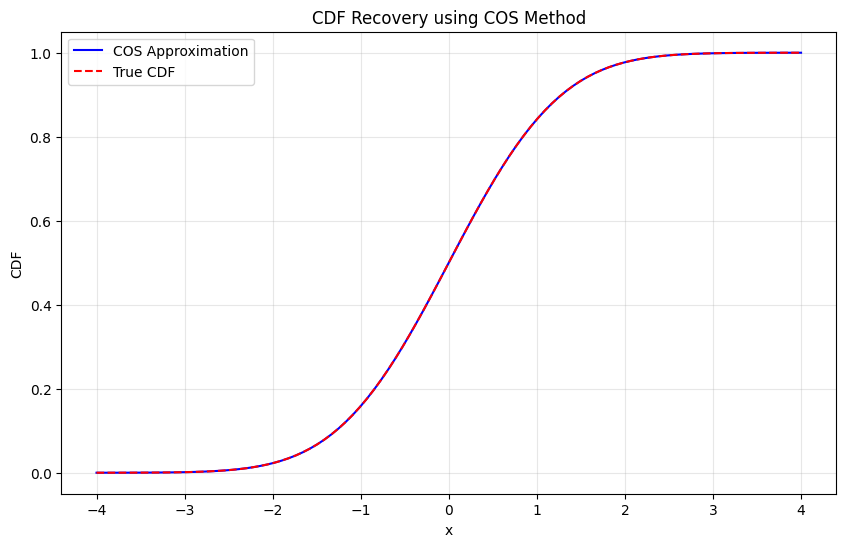
Maximum CDF error: 4.44e-16
1.2. Carr-Madan Method#
Uses Gil-Pelaez inversion. The CDF:
The PDF via inverse Fourier transform:
For numerical stability (especially heavy tails), add a damping factor \(\alpha > 0\):
Then recover: \(f(x) = e^{\alpha x} f_{\alpha}(x)\).
Truncate to \([-u_{\max}, u_{\max}]\) and use FFT for \(O(N \log N)\) complexity. Convergence is algebraic: \(O(N^{-p})\) where \(p\) depends on how fast \(|\varphi(u)|\) decays.
Damping \(\alpha \in [0.5, 1.5]\) works for most cases. Sensitive to parameter choice — need to tune \(\alpha\) and \(u_{\max}\).
Same test as COS. Carr-Madan needs more grid points since convergence is algebraic.
Convergence plot and table:
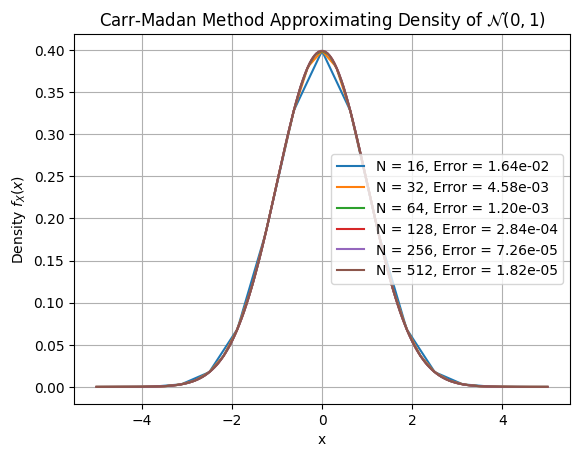
     N     Error  CPU time (msec.)  Diff. in CPU (msec.)
0   16  0.016351          0.107002                   NaN
1   32  0.004577          0.079298             -0.027704
2   64  0.001203          0.074434             -0.004864
3  128  0.000284          0.107098              0.032663
4  256  0.000073          0.051022             -0.056076
5  512  0.000018          0.072336              0.021315

Testing CDF recovery:
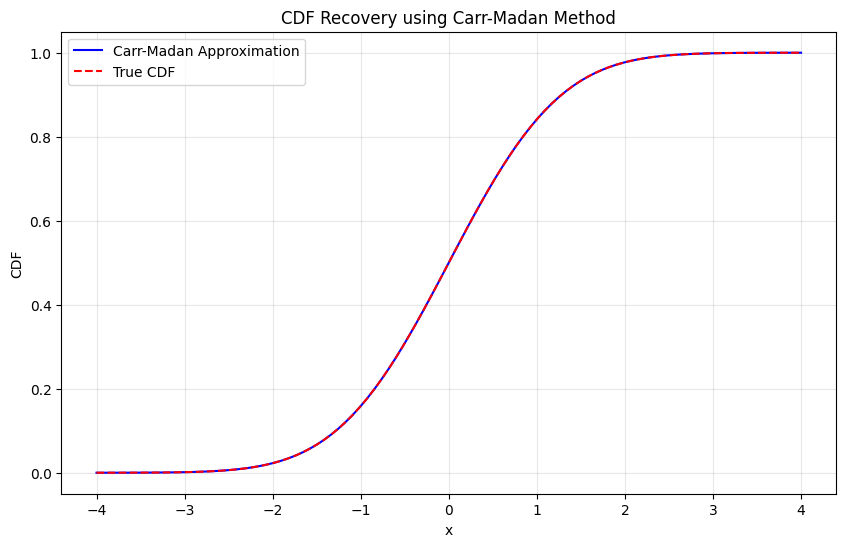
Maximum CDF error: 1.27e-10
1.3. CONV Method#
Discretizes the inverse Fourier transform and uses FFT. Same underlying formula as Carr-Madan:
Grid setup:
Spatial: \(x_k = x_{\min} + k \cdot \Delta x\)
Frequency: \(u_j = j \cdot \Delta u\) where \(\Delta u = 2\pi / L\) and \(L = x_{\max} - x_{\min}\)
The discrete approximation:
This is just an inverse DFT — use np.fft.fft with proper scaling.
Add damping \(\alpha\) for stability with heavy tails, same as Carr-Madan. The phase correction \(e^{-iu_j x_{\min}}\) shifts the output to the desired spatial domain.
Complexity: \(O(N \log N)\). More robust than Carr-Madan for unknown distributions. Convergence is spectral for smooth CFs, algebraic otherwise.
Same test. CONV uses FFT with phase correction — similar to Carr-Madan but different grid handling.
Testing PDF recovery:
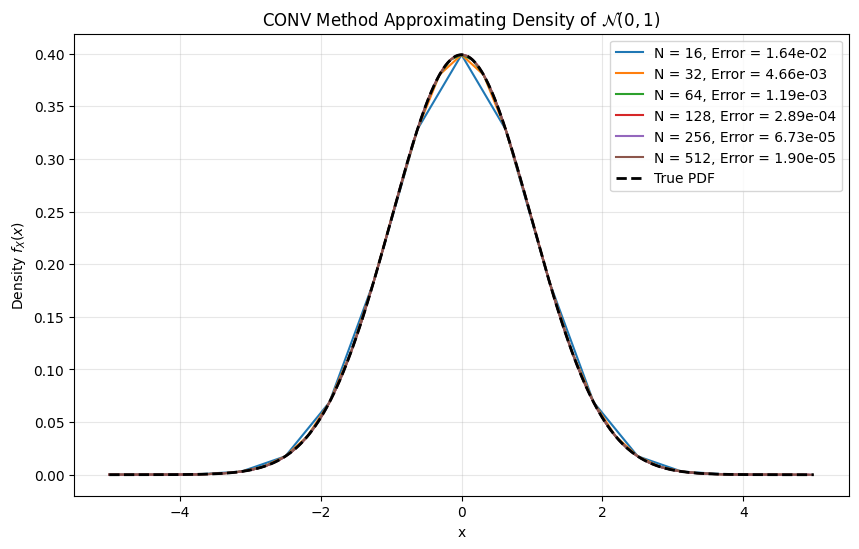
Convergence table:
     N     Error  CPU time (msec.)  Diff. in CPU (msec.)
0   16  0.016413          0.118780                   NaN
1   32  0.004663          0.104642             -0.014138
2   64  0.001192          0.104499             -0.000143
3  128  0.000289          0.109625              0.005126
4  256  0.000067          0.112200              0.002575
5  512  0.000019          0.184894              0.072694

Testing CDF recovery:
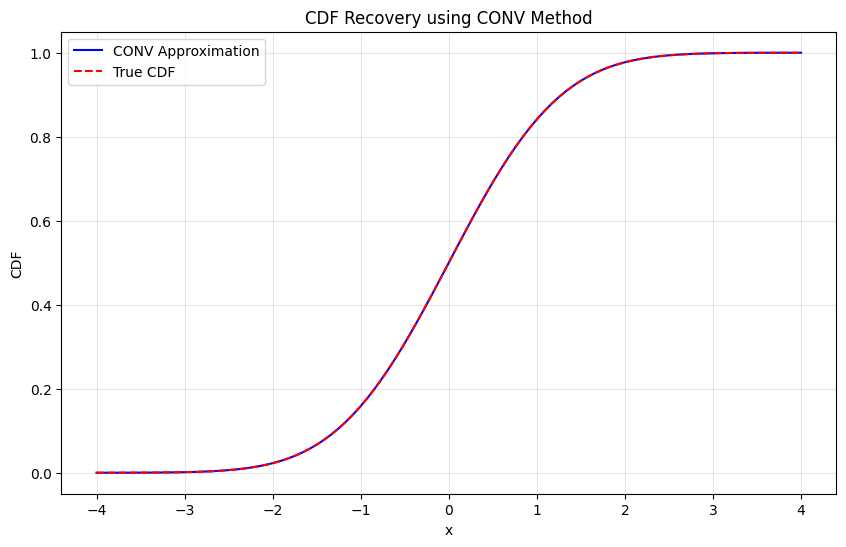
Maximum CDF error: 7.56e-07
======================================================================
CONVERGENCE COMPARISON: Maximum Absolute Error
======================================================================
Method      CONV           COS  Carr-Madan
N
16      0.016413  7.172372e-03    0.016416
32      0.004663  4.032330e-07    0.004663
64      0.001192  3.608225e-16    0.001193
128     0.000289  3.608225e-16    0.000289
256     0.000067  3.608225e-16    0.000067


======================================================================
PERFORMANCE COMPARISON: CPU Time (milliseconds)
======================================================================
Method      CONV       COS  Carr-Madan
N
16      0.102997  0.162315    0.036621
32      0.098491  0.212002    0.033498
64      0.100017  0.398946    0.035882
128     0.107312  0.782943    0.039887
256     0.120211  1.553893    0.046682
| N | Method | Error | CPU time (ms) | |
|---|---|---|---|---|
| 0 | 16 | COS | 7.172372e-03 | 0.162315 |
| 1 | 16 | Carr-Madan | 1.641613e-02 | 0.036621 |
| 2 | 16 | CONV | 1.641260e-02 | 0.102997 |
| 3 | 32 | COS | 4.032330e-07 | 0.212002 |
| 4 | 32 | Carr-Madan | 4.663137e-03 | 0.033498 |
| 5 | 32 | CONV | 4.662527e-03 | 0.098491 |
| 6 | 64 | COS | 3.608225e-16 | 0.398946 |
| 7 | 64 | Carr-Madan | 1.192675e-03 | 0.035882 |
| 8 | 64 | CONV | 1.192463e-03 | 0.100017 |
| 9 | 128 | COS | 3.608225e-16 | 0.782943 |
| 10 | 128 | Carr-Madan | 2.887765e-04 | 0.039887 |
| 11 | 128 | CONV | 2.886811e-04 | 0.107312 |
| 12 | 256 | COS | 3.608225e-16 | 1.553893 |
| 13 | 256 | Carr-Madan | 6.734658e-05 | 0.046682 |
| 14 | 256 | CONV | 6.730085e-05 | 0.120211 |
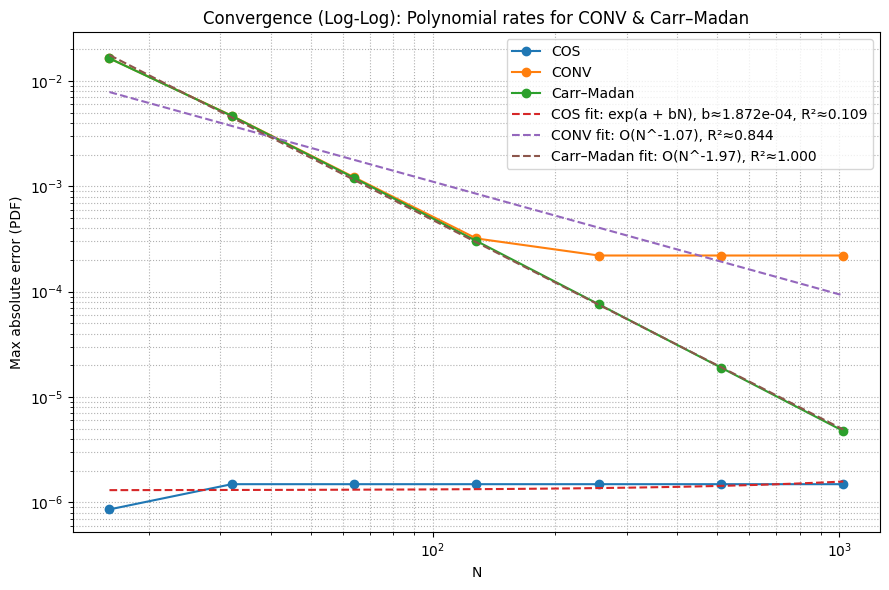
=== Empirical Convergence Summary ===
COS: last N=1024, error=1.487e-06, R²≈0.109
CONV: last N=1024, error=2.206e-04, R²≈0.844
Carr–Madan: last N=1024, error=4.753e-06, R²≈1.000
From the convergence plots: COS reaches machine precision at N~64 for the standard normal, while Carr-Madan and CONV need N~256+. COS is the obvious choice for smooth distributions. Carr-Madan handles heavier tails better. CONV is the most robust but slowest.
TODO: compare on heavier-tailed distributions (Variance Gamma, NIG) where the COS advantage may shrink.